The five myths we hear most: extensions ruin your natural lashes, you can't get them wet, every set looks the same, they feel heavy, and you'll still need mascara. Not one of them survives a well-trained artist and a properly mapped set. Here's the truth behind each — calmly, and without the sales pitch.
Myth one: "Extensions ruin your natural lashes"
This is the big one, and it deserves a straight answer: extensions applied correctly do not damage natural lashes.
The damage stories you've heard are real — but they come from poor technique: extensions that are too heavy for the natural lash carrying them, clusters glued across multiple lashes, or sets applied with no regard for what your lashes can support. That's a training problem, not an extension problem.
Done properly, one lightweight extension is attached to one natural lash, and the weight and length are checked against what that lash can comfortably carry. At Aries Lash, nothing is applied that your lashes can't happily carry — lash health is checked at every visit, because a full look should never come at your lashes' expense.
Myth two: "You can't wash them"
The opposite is true: you must. Skipping cleansing is one of the most common aftercare mistakes there is.
Lashes collect the day — makeup residue, skincare, everything the air brings. Left alone, that build-up settles along the lash line, and neither your extensions nor your natural lashes are better for it. A gentle, lash-safe foam a few times a week keeps everything clean, and a clean set retains noticeably better than a neglected one.
The only time to keep lashes fully dry is the first 24 hours after your appointment. After that, wash without worry.
Myth three: "Every set looks the same"
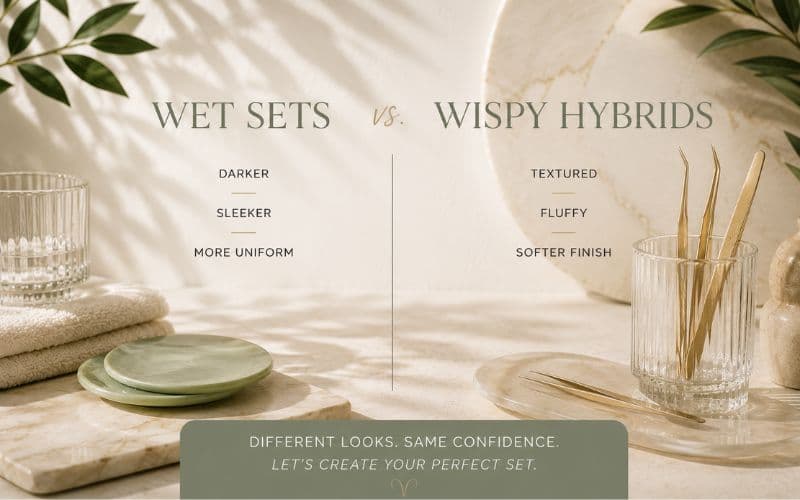
Only if they're applied the same — which is exactly what a custom set is not.
A well-made set starts with mapping: your artist plans lengths and curls to your eye shape — round, almond, hooded, or downturned — placing them to open and lift your eyes rather than simply add to them. It's the difference between "lashes" and lashes that look like you.
It's also why the same style reads differently on different people. A classic set on one client and a classic set on another are two different maps. The style is the starting point; your eyes decide the rest.
Myth four: "They feel heavy"
A properly weighted set is feather-light — most clients forget they're wearing anything at all.
Modern extension fibers are extremely fine; even a dense volume set stays within a safe, comfortable weight because each handmade fan is built from fibers finer than a natural lash. And the appointment itself is the opposite of an ordeal: you rest with your eyes closed while each lash is placed one at a time. Most first-timers drift off.
If a set ever feels heavy, pokey, or uncomfortable, that's not something to push through — it's a sign the work wasn't right, and worth having looked at.
Myth five: "You'll still need mascara"
You won't — that's much of the appeal. A mapped set gives you the definition mascara was approximating, minus the morning routine and the evening removal.
If you ever want extra for an occasion, a water-based, lash-safe mascara on the tips only is the most your set should meet. Waterproof formulas, never — they demand the kind of scrubbing that no set survives gracefully.
The honest summary
Extensions have a reputation problem that good work quietly disproves. In careful hands, they're safe for your natural lashes, easy to live with, comfortable to wear, and entirely yours in shape and style.
If you're lash-curious but have been held back by one of these myths, our new here guide walks through exactly what a first visit looks like — and if you'd rather just ask your questions in person, book a visit. The consultation is part of every appointment, and no question is too small.